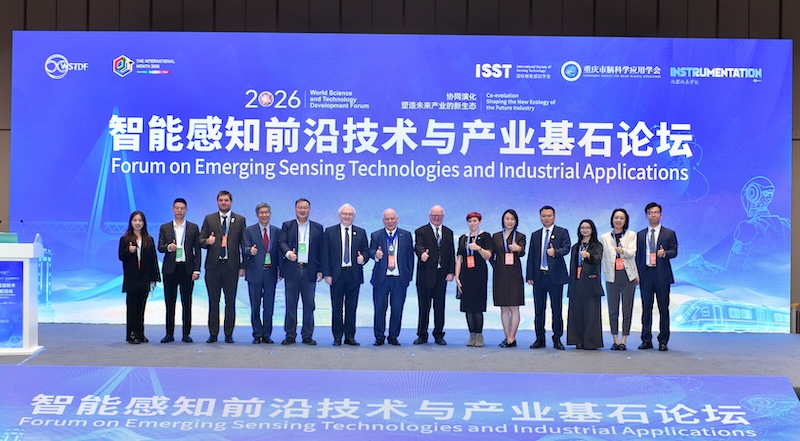
The opening ceremony of the 2026 World Science and Technology Development Forum was held at Chongqing Science Hall on the morning of October 21. That afternoon, the Forum on Emerging Sensing Technologies and Industrial Applications convened as a parallel session, bringing together keynote presentations, research releases, and discussions on technological innovation, technology transfer, and international cooperation.
Led by the International Society of Sensing Technology (ISST), with support from the Chongqing Society for Brain Science Application and the journal Instrumentation, the forum explored the foundational role of intelligent sensing in artificial intelligence, the Internet of Things, and advanced equipment manufacturing. Discussions focused on emerging technologies and collaboration across the sensing value chain.
Five keynote presentations covered fiber-optic sensing, the transition from computational sensing to empathetic interaction, future wireless technologies for physical AI, optical sensing for industrial monitoring, and the integration of AI into healthcare. Drawing on research advances and industry needs, speakers examined key challenges in translating sensing technologies into practical applications, offering insights for interdisciplinary research and collaboration between academia and industry.
The Intelligent Sensing Industry Landscape 2026 was officially released during the forum. The publication systematically examines the sector’s technologies, value chain, regional ecosystems, and development trends. Its analytical framework combines five technology layers with three major categories of sensing modalities, mapping connections across the value chain, key application scenarios, and technology development pathways. It provides a reference for research planning, industrial policymaking, business development, and industry collaboration.
The forum also marked the launch of ISST Young, a program to develop young professionals for international scientific and technological organizations. The program will recruit and nurture young talent in sensing technology from around the world. Together, the two initiatives support continued innovation through industry research and talent development.
As communication and sensing technologies converge and applications expand into embodied AI, the low-altitude economy, and smart healthcare, the sector increasingly depends on interdisciplinary collaboration, stronger value-chain connections, and international exchange. By linking technological research, industry analysis, talent development, and practical applications, the forum provided a platform for connecting expertise and resources across the sensing ecosystem.
Building on the forum, ISST will continue to advance industry research, technical exchange, and international cooperation. Drawing on the industry landscape publication, it will pursue focused studies in specific sensing fields and facilitate connections across the value chain to accelerate the transfer and application of sensing innovations.


)


